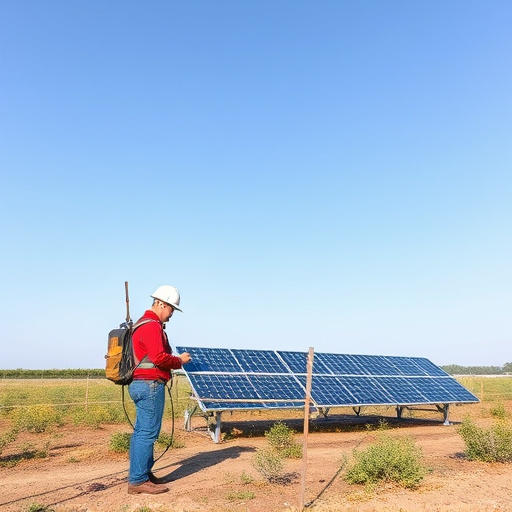
Microinverters revolutionize Solar Power by optimising panel efficiency, increasing production up to 10%. They manage individual panels, ensuring maximised output despite shading or temperature variations. Safety is enhanced through isolated panel management and system continuity during issues. Strategic implementation requires site-specific analysis, offering efficient, resilient solar energy generation for a sustainable future.
The global shift towards sustainable energy solutions has Solar Power at the forefront of innovation. As we strive for a greener future, optimizing existing technology is paramount. One such advancement in the realm of solar energy efficiency are microinverters, which offer immense potential to enhance panel-level performance. Currently, traditional inverters can be a bottleneck for overall system efficiency due to string dependencies and centralized control. This article delves into how microinverters, by independently optimizing each solar panel, overcome these limitations, resulting in increased energy production and improved system reliability.
- Understanding Microinverters: Unlocking Solar Panel Efficiency Secrets
- Implement and Optimize: Maximizing Solar Power Generation with Microinverters
Understanding Microinverters: Unlocking Solar Panel Efficiency Secrets

Microinverters have emerged as a game-changer in the realm of solar power, offering an innovative solution to enhance panel-level efficiency. These compact devices, connected directly to individual solar panels, unlock the full potential of each module, optimizing energy production even in challenging conditions. Unlike traditional string inverters, microinverters provide independent power management for each panel, allowing them to operate at their maximum capacity. This tailored approach ensures that no energy is left untapped, even when facing varying shading patterns or temperature fluctuations.
The efficiency gains are significant, with studies showing that microinverters can increase overall system performance by up to 10%. For instance, in a residential setup with multiple panels, each equipped with a microinverter, the system achieved a higher average DC-to-AC conversion rate compared to a traditional string inverter configuration. This improved efficiency translates into more electricity generated over time, ultimately reducing the payback period for solar installations. Moreover, microinverters provide enhanced safety features, as they isolate individual panels, minimizing the impact of any potential issues and ensuring the rest of the system remains operational.
Implementing microinverters requires careful planning and selection based on specific site conditions. System designers must consider factors like panel orientation, shading analysis, and temperature profiles to maximize the benefits. As solar power continues to evolve, embracing technologies like microinverters allows for more efficient and resilient energy generation. This strategic approach ensures that solar installations deliver optimal performance, contributing to a sustainable future.
Implement and Optimize: Maximizing Solar Power Generation with Microinverters

Implementing and optimizing microinverters is a strategic approach to maximizing solar power generation from photovoltaic (PV) panels. These innovative devices, connected directly to individual solar panels, offer significant advantages over traditional string inverters. By monitoring and managing each panel independently, microinverters enhance overall system performance, especially in installations with varying shading patterns or uneven panel orientations. For instance, a study by the National Renewable Energy Laboratory (NREL) revealed that microinverter systems can increase energy production by up to 10% compared to string inverters in commercially scalable PV arrays.
Maximizing solar power generation requires a nuanced understanding of site-specific conditions and strategic microinverter deployment. One key optimization technique is load balancing, where panels with higher energy output are paired with those generating less, ensuring a more consistent power delivery. This approach not only minimizes voltage fluctuations but also maximizes the utilization of grid connections, leading to improved overall system efficiency. For example, in a large-scale solar farm, employing microinverters enabled engineers to achieve a 2% increase in total energy production by meticulously balancing the output across different panels, even under dynamic weather conditions.
Additionally, advanced microinverter technologies offer features like maximum power point tracking (MPPT) and adaptive shading algorithms, further enhancing performance. MPPT ensures that each panel operates at its optimal voltage for maximum power extraction, while adaptive shading algorithms dynamically adjust panel settings to compensate for passing clouds or nearby obstructions. These capabilities translate into increased energy capture, even during periods of varying sunlight conditions. By continuously monitoring and optimizing these parameters, solar installations can achieve higher energy yields over extended periods, solidifying the role of microinverters as a game-changer in the pursuit of sustainable Solar Power generation.
Microinverters play a pivotal role in enhancing solar panel efficiency and maximizing Solar Power generation. By understanding their functionality and implementing strategic optimization techniques, homeowners and businesses alike can significantly improve the performance of their solar systems. Key takeaways include the ability of microinverters to protect individual panels, adapt to varying energy demands, and optimize power production even under less-than-ideal conditions. Moving forward, integrating microinverters into solar installations offers a practical path toward more efficient Solar Power generation, ensuring optimal returns on investment and contributing to a sustainable future.